
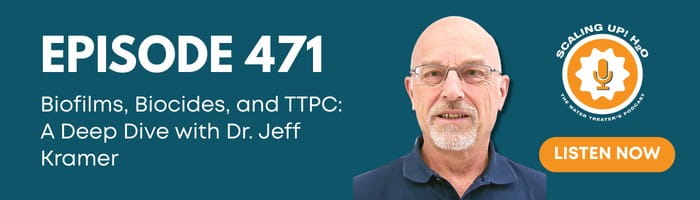
Chattanooga (April 10, 2026): In Episode 471, Scaling UP! H2O welcomes Dr. Jeff Kramer, Technical Director of Radical Polymers (a division of MFG Chemical), for a highly practical conversation on biofilms, biocide program design, and TTPC performance in real cooling-water conditions. In this episode, host Trace Blackmore and Dr. Jeff draw on their long professional history, including a 2006 TTPC field trial, to unpack what water treaters need to know to control biofilm, protect heat transfer, and avoid common program pitfalls.
Biofilm Basics: What It Is and Why It’s Everywhere: Dr. Jeff defines biofilm as microorganisms attaching to surfaces and forming a community protected by an external matrix, illustrated with a simple analogy many have experienced (the “slimy rock” effect). He also notes that biofilm is essentially a given in the systems that water treaters manage.
The Real-World Impact: Heat Transfer, Corrosion, and Legionella: The conversation highlights three key consequences of biofilm in cooling systems:
Building a Strong Biocide Program: Dr. Jeff outlines a practical program approach: establish an oxidizing biocide foundation (chlorine or bromine). Then, supplement with a non-oxidizer, ideally one that can kill and remove biofilm, not just kill organisms while leaving the film behind.
Inside the Lab: How Biofilm Performance Is Evaluated: Trace asks Dr. Jeff to explain how suppliers test biofilm control. Dr. Kramer describes approaches that include coupon-based biofilm growth and evaluation, using tools such as sonication for viable counts and microscopy/staining to assess remaining biofilm on surfaces.
Dose Strategy and Timing: Why “It Depends” (and What to Watch):
Dr. Jeff explains why label dosage ranges exist and shares his experience that, for many non-oxidizers, a higher shock dose for a defined period can be more effective than spreading the same total amount across frequent, smaller feeds. He also
emphasizes compatibility; some non-oxidizers have halogen demand, which can reduce performance if applied at the wrong time, so adjustments should be guided by system feedback and data.
Surfactants and Quats: Improving Speed and Penetration: The episode explains how surfactants and quaternary compounds can disrupt microbial membranes, helping oxidizers and non- oxidizers penetrate faster and potentially improving
performance when compatible combinations are used.
Foam Management: What to Expect During Cleanup: Dr. Jeff addresses foam that may come from certain chemistries and from cleaning up a dirty system. His practical guidance: be prepared to address customer concerns and keep a defoamer on hand. When asked about silicone vs. non-silicone defoamers, he notes he has heard the claims but has not seen data to confirm them.
TTPC: Materials, Performance, and PTSA Interference: Trace and Dr. Jeff revisit TTPC lessons, including the importance of materials of construction (with an emphasis on using appropriate plastics and avoiding PVC, especially with concentrated material). They also cover TTPC’s operational interference with PTSA fluorescence (quenching), how this was discovered through field feedback, and how controls/program adjustments can help manage the issue.
Residence Time: A Practical Selection Factor: Dr. Jeff explains residence time/turnover and why it matters: systems with short residence time often require products that deliver faster kill.
Looking Ahead: What’s Next in Microbicides: Dr. Kramer shares that innovation continues, especially around biocide blends, and discusses why multi-active approaches can perform well across different microbial challenges and field conditions.
Scaling UP! H2O is the go-to podcast for water treatment professionals, bringing together industry leaders and innovators to share knowledge, strategies, and stories that elevate the entire community.
Hosted by Trace Blackmore, each episode delivers practical insights and inspiration for professionals at every stage of their career.
Tune in to hear Dr. Jeff Kramer’s episode: Click HERE.
Choose Your Favorite Podcast Platform and Subscribe HERE.
Radical Polymers is a division of MFG Chemical and a specialized team of chemists with nearly 40 years of expertise in the design and application of water treatment additives. Listen or watch more water treatment podcasts and webinars here. The company’s INITIA® polymer additive product line is built to give water treaters customized tools for challenging applications, and Radical Polymers has also been recognized by the Association of Water Technologies (AWT) as “Supplier of the Year.”
Dr. Jeff Kramer’s Connection: In this episode, Dr. Kramer is introduced as the Technical Director of Radical Polymers (a division of MFG Chemical). MFG Chemical notes that in his technical director role within its Water Additives organization, he focuses on developing new water treatment products and working directly with customers to address water treatment challenges and deliver effective solutions.
Don’t miss this episode. Share it with your network and sharpen your biofilm control strategy with a practical, experience-backed deep dive into biocides, TTPC, and system feedback.
Media Contact:
Jon Amdursky
MFG Chemical
jamdursky@mfgchemical.com